
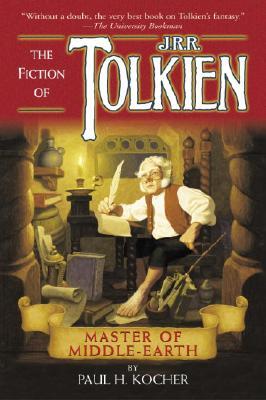
Master of Middle-Earth the Fiction of J. R. R. Tolkien
- List Price: $12.95
- Binding: Paperback
- Publisher: Ballantine Books
- Publish date: 08/01/2003
Description:
CHAPTER I MIDDLE-EARTH: AN IMAGINARY WORLD? In 1938 when Tolkien was starting to write The Lord of the Rings he also delivered a lecture at the University of St. Andrews in which he offered his views on the types of world that it is the office of fantasy, including his own epic, to "sub-create," as he calls it. Unlike our primary world of daily fact, fantasy's "secondary worlds" of the imagination must possess, he said, not only "internal consistency" but also "strangeness and wonder" arising from their "freedom from the domination of observed fact."1 If this were all, the secondary world of faery would often be connected only very tenuously with the primary world. But Tolkien knew, none better, that no audience can long feel sympathy or interest for persons or things in which they cannot recognize a good deal of themselves and the world of their everyday experience. He therefore added that a secondary world must be "credible, commanding Secondary Belief." And he manifestly expected that secondary worlds would combine the ordinary with the extraordinary, the fictitious with the actual: "Farie contains many things besides elves and fays, and besides dwarfs, witches, trolls, giants, or dragons: it holds the seas, the sun, the moon, the sky; and the earth and all things that are in it: tree and bird, water and stone, wine and bread, and ourselves, mortal men, when we are enchanted." Tolkien followed his own prescription in composing The Lord of the Rings, or perhaps he formulated the prescription to justify what he was already intending to write. In either case the answer to the question posed by the title of this chapter is "Yes, but-." Yes, Middle-earth is a place of many marvels. But they are all carefully fitted into a framework of climate and geography, familiar skies by night, familiar shrubs and trees, beasts and birds on earth by day, men and manlike creatures with societies not too different from our own. Consequently the reader walks through any Middle-earth landscape with a security of recognition that woos him on to believe in everything that happens. Familiar but not too familiar, strange but not too strange. This is the master rubric that Tolkien bears always in mind when inventing the world of his epic. In applying the formula in just the right proportions in the right situations consists much of his preeminence as a writer of fantasy. Fundamental to Tolkien's method in The Lord of the Rings is a standard literary pose, which he assumes in the Prologue and never thereafter relinquishes even in the Appendices: that he did not himself invent the subject matter of the epic but is only a modern scholar who is compiling, editing, and eventually translating copies of very ancient records of Middle-earth which have come into his hands, he does not say how. To make this claim sound plausible he constructs an elaborate family tree for these records, tracing some back to personal narratives by the four hobbit heroes of the War of the Ring, others to manuscripts found in libraries at Rivendell and Minas Tirith, still others to oral tradition.2 Then, in order to help give an air of credibility to his account of the War, Tolkien endorses it as true and calls it history, that is, an authentic narrative of events as they actually happened in the Third Age. This accolade of history and historical records he bestows frequently in both Prologue and Appendices. With the Shire Calendar in the year 1601 of the Third Age, states the Prologue, ". . . legend among the Hobbits first becomes history with a reckoning of years." A few pages farther on, Bilbo's 111th birthday is said to have occurred in Shire year 1041: "At this point this History begins." And in Appendix F Tolkien declares editorially, "The language represented in this history by English was the Westron or 'Common Speech' of the West-lands of Middle-earth in the Third Age."3 Many writers of fantasy would have stopped at this point. But Tolkien has a constitutional aversion to leaving Middle-earth afloat too insubstantially in empty time and place, or perhaps his literary instincts warn him that it needs a local habitation and a name. Consequently he takes the further crucial step of identifying it as our own green and solid Earth at some quite remote epoch in the past. He is able to accomplish this end most handily in the Prologue and Appendices, where he can sometimes step out of the role of mere editor and translator into the broader character of commentator on the peoples and events in the manuscripts he is handling. And he does it usually by comparing conditions in the Third Age with what they have since become in our present. About the hobbits, for instance, the Prologue informs the reader that they are "relations of ours," closer than elves or dwarves, though the exact nature of this blood kinship is lost in the mists of time. We and they have somehow become "estranged" since the Third Age, and they have dwindled in physical size since then. Most striking, however, is the news that "those days, the Third Age of Middle-earth, are now long past, and the shape of all lands has been changed; but the regions in which Hobbits then lived were doubtless the same as those in which they still linger: the North-West of the Old World, east of the Sea." There is much to digest here. The Middle-earth on which the hobbits lived is our Earth as it was long ago. Moreover, they are still here, and though they hide from us in their silent way, some of us have sometimes seen them and passed them on under other names into our folklore. Furthermore, the hobbits still live in the region they call the Shire, which turns out to be "the North-West of the Old World, east of the Sea." This description can only mean northwestern Europe, however much changed in topography by eons of wind and wave. Of course, the maps of Europe in the Third Age drawn by Tolkien to illustrate his epic show a continent very different from that of today in its coastline, mountains, rivers, and other major geographical features. In explanation he points to the forces of erosion, which wear down mountains, and to advances and recessions of the sea that have inundated some lands and uncovered others. Singing of his ancestor Durin, Gimli voices dwarf tradition of a time when the earth was newly formed and fair, "the mountains tall" as yet unweathered, and the face of the moon as yet unstained by marks now visible on it. Gandalf objects to casting the One Ring into the ocean because "there are many things in the deep waters; and seas and lands may change." Treebeard can remember his youth when he wandered over the countries of Tasarinan, Ossiriand, Neldoreth, and Dorthonion, "And now all those lands lie under the wave." At their parting Galadriel guesses at some far distant future when "the lands that lie under the wave are lifted up again" and she and Treebeard may meet once more on the meadows of Tasarinan. Bombadil recalls a distant past, "before the seas were bent." By many such references Tolkien achieves for Middle-earth long perspectives backward and forward in geological time. One episode in particular, the reign of Morgoth from his stronghold of Thangorodrim somewhere north of the Shire for the three thousand years of the First Age, produces great changes in Middle-earth geography. To bring about his over-throw the Guardian Valar release titanic natural forces, which cause the ocean to drown not only his fortress but a vast area around it, including the elf kingdoms of Beleriand, Nargothrond, Gondolin, Nogrod, and Belagost. Of that stretch of the northwestern coast only Lindon remains above the waves to appear on Tolkien's Third Age maps. The flooding of rebellious Nmenor by the One at the end of the Second Age is a catastrophe of equal magnitude. But Tolkien gives the realm of Morgoth an extra level of allusiveness by describing it as so bitterly cold that after its destruction "those colds linger still in that region, though they lie hardly more than a hundred leagues north of the Shire." He goes on to describe the Forodwaith people living there as "Men of far-off days," who have snow houses, like igloos, and sleds and skis much like those of Eskimos. Add the fact that the Witch-king of Angmar (thereafter called simply Angmar), Morgoth's henchman, has powers that wane in summer and wax in winter, and it becomes hard not to associate Morgoth in some way with a glacial epoch, as various commentators have already done. In his essay "On Fairy-stories" Tolkien refuses to interpret the Norse god Thrr as a mere personification of thunder.4 Along the same lines, it is not his intention, I think, to portray Morgoth as a personification of an Ice Age. However, it would seem compatible with his meaning to consider Morgoth a spirit of evil whose powers have engendered the frozen destructiveness of such an age. The possibility thus raised of fixing the three Ages of Middle-earth in some interglacial lull in the Pleistocene is tempting, and may be legitimate, provided that we do not start looking about for exact data to establish precise chronologies.5 The data are not there, and Tolkien has no intention whatever of supplying them. The art of fantasy flourishes on reticence. To the question how far in Earth's past the Ages of Middle-earth lie, Tolkien gives essentially the storyteller's answer: Once upon a time-and never ask what time. Choose some interglacial period if you must, he seems to say, but do not expect me to bind myself by a
Expand description
Product notice
Returnable at the third party seller's discretion and may come without consumable supplements like access codes, CD's, or workbooks.


Please Wait